
Low-Volume Injection Molding: Getting 100 to 5,000 Parts Without Production-Tool Prices
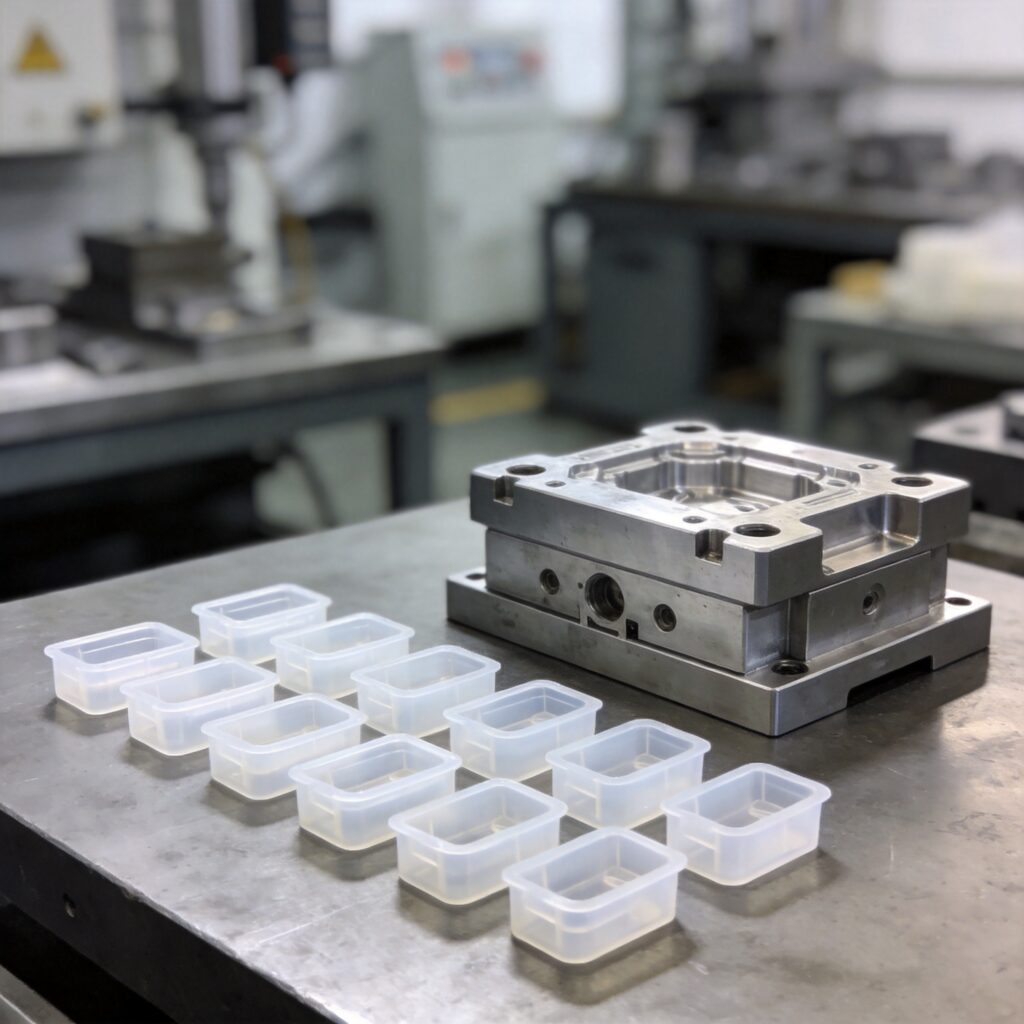
One of the first questions buyers ask us is some version of “what is your MOQ?” The honest answer for low-volume injection molding is: lower than most people assume. You do not need a 100,000-piece forecast to justify a real molded part. What you do need is a tool built for the volume you actually expect, instead of one built for a million shots you may never run.
That distinction is where most low-volume projects either save money or waste it.
Why a production mold is the wrong tool for a pilot run
A hardened P20 or 718H production mold is built to survive hundreds of thousands, sometimes over a million cycles. It gets hardened inserts, automatic side actions, hot runners, and generous cooling. That engineering is worth every dollar at high volume, because it drives cycle time down. At 500 pieces it is pure overhead — the mold cost lands on parts that never exist.
For small batch injection molding we use what the industry calls soft tooling or rapid tooling: a simplified aluminum or mild-steel mold that is cut fast and run hard for a short life. Aluminum cuts quickly on the CNC, polishes easily, and conducts heat well, which keeps cycle times respectable even with basic cooling lines. Depending on geometry and resin, a well-built aluminum tool comfortably delivers somewhere in the range of 1,000 to 5,000 shots; a simple mild-steel insert mold pushes past 10,000.
How we cut tooling cost for low-volume runs
- Manual side actions instead of hydraulic or cam pulls. A hand-loaded insert that an operator removes each cycle adds a few seconds of labor, which is invisible at 2,000 parts and removes real money from the mold price.
- Simple gating. We use edge or submarine gates trimmed by hand instead of hot-tip systems. Slightly more finishing work, dramatically less tool cost.
- Single cavity, or a small family mold. Two related parts sharing one mold base can be cheaper than two separate tools.
- Stock resin grades and standard colors. Custom-color compounds carry minimum order weights that dwarf the part itself; black, white, and natural resins usually sit on the shelf.
- Class B or C surfaces where nobody sees them. Cosmetic specs drive polishing time. Specify texture only on visible faces.
Low-volume molding vs 3D printing and vacuum casting
We do run 3D printing and vacuum forming in-house, so this is not a hard sell toward steel. The rough guide we give buyers:
- 1 to 50 units: SLS, SLA, or CNC usually wins. There is no tooling to amortize and changes are free.
- 50 to 500 units: silicone vacuum casting for enclosures and appearance parts, especially when the material spec is forgiving.
- 500 to 10,000 units, or parts that must pass real testing: low-volume injection molding. You get production-grade resin, real snap fits, actual threads, and isotropic strength — properties that prototypes simply cannot fake.
The crossover usually happens the moment the part has to meet a flammability rating, survive a drop test, or clip into another production component. At that point only the genuine process will do.
Bridge tooling: stop choosing between prototype and production
Crowdfunding campaigns, first product launches, and regional market tests are exactly what bridge tooling is for. We build a fast, affordable mold, run your first 2,000 units to generate revenue and field feedback, and start designing the hardened production tool only after the design has proven itself. The bridge mold is written off as a launch cost; the design changes it pays for never become expensive steel re-cuts.
If the product takes off, you have shipped real parts already. If it needs a redesign, you found out on a $2,000 tool instead of a $20,000 one.
Getting an honest low-volume quote
Share your annual estimate, but also tell us the first order quantity. Those are different numbers and they change the tool strategy completely. A China injection molding partner that only quotes production-grade tooling for every project is not optimizing for your risk — they are optimizing for their own order size.
Tell us your part, your first batch, and your 12-month forecast. We will quote the tooling tier that actually fits — get a low-volume injection molding quote.